Direct Answer
I chose the Gesture — adjustable seat depth and 360° armrests outweighed the Aeron's breathability advantage for my workflow
For tall users 6'0"–6'3" who run warm, the Aeron's Pellicle mesh is unmatched. For users who work across multiple devices or need adjustable seat depth, the Gesture's 360° armrests and 15.75"–18.75" depth range are the better fit. Both are strong choices — the difference is comfort philosophy, not quality.
For users 6'0"–6'3": both chairs meet dimensional requirements — the decision is breathability preference (Aeron) vs arm positioning flexibility (Gesture). For users 6'2"–6'4": the Gesture's adjustable seat depth (up to 18.75") and taller seat height ceiling (21" vs 20.5") give it a dimensional edge. Above 6'4": the Steelcase Leap Plus (19.75" depth, 25.5" back, and 22.5" seat height with its optional 5" cylinder — 19.5" without) is the recommended primary option once both chairs here run out of height ceiling.
Overview
TCA's Aeron Size C versus Gesture comparison concludes in favor of the Steelcase Gesture at 6 feet 4 inches, on the grounds that adjustable seat depth and 360-degree armrests outweigh the Aeron's superior mesh breathability. The Aeron Size C remains competitive for users who prioritize heat management, but its fixed seat depth is the constraint that decides the comparison for taller users.
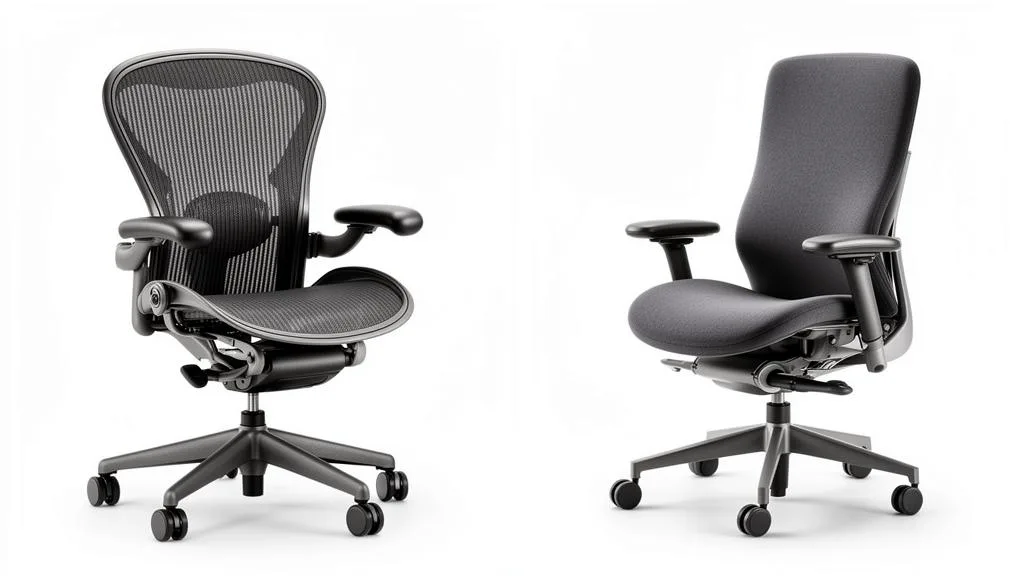
The Herman Miller Aeron Size C and Steelcase Gesture represent two distinct philosophies in ergonomic seating. The Aeron — originally launched in 1994 and remastered in 2016 — is built around mesh suspension, PostureFit lumbar support, and a shape derived from deep biomechanical research. The Gesture was designed a decade later for a different problem: how people actually work with multiple devices throughout the day.
For tall users comparing them, the decision usually comes down to three things: breathability preference, seat depth (the Aeron's is fixed; the Gesture's adjusts), and how much arm support variety matters to your workflow.
Key Specifications
| Specification | Aeron Size C | Steelcase Gesture |
|---|---|---|
| Seat Height Range | 16" – 20.5" | 16" – 21" |
| Seat Depth | ~18.5" (fixed) | 15.75" – 18.75" (adjustable) |
| Back Height | ~23.5" | 24" |
| Seat Width | 20.75" | 19.25" |
| Weight Capacity | 350 lbs | 400 lbs |
| Seat Material | Pellicle mesh | Foam cushion |
| Back Material | Pellicle mesh | Flexible plastic shell |
| Lumbar Support | PostureFit SL (manual) | LiveBack (automatic) |
| Armrests | 4D adjustable | 360° rotation |
| Forward Tilt | Yes | No |
| Tall Cylinder Option | No | Yes (dealer) |
| Warranty | 12 years | 12 years |
The Seat Depth Difference: The Most Important Factor for Tall Users
The single biggest ergonomic difference between these two chairs for tall users is seat depth — specifically, that the Aeron's is fixed and the Gesture's adjusts.
The Aeron Size C has a seat depth of approximately 18.5 inches. You cannot change this. For most tall users 6'0"–6'3" with typical proportions, 18.5" provides good thigh support with the right amount of clearance behind the knee. But if your thigh length doesn't match — either too long or too short — you're left with a chair that doesn't fit correctly, with no way to adjust your way out of it.
The Steelcase Gesture's seat depth adjusts from 15.75" to 18.75". This slider lets you dial in thigh support precisely for your body. At maximum extension, it's 0.25" deeper than the Aeron — a minor difference — but the key advantage is the ability to tune the setting. If the Aeron's 18.5" is slightly short for your femur length, the Gesture's slider lets you extend to whatever you need up to 18.75".
Practical implication: If you can verify that 18.5" matches your thigh length, the Aeron's fixed depth is not a problem. If you're unsure, or if your proportions are unusual for your height, the Gesture's adjustable depth reduces that risk.
Breathability: Clear Aeron Advantage
The Aeron's Pellicle mesh — covering both the seat and back — allows continuous airflow across the entire sitting surface. There is no fabric-to-skin contact trapping heat; the mesh suspends you and allows air to pass through on both sides.
The Steelcase Gesture uses a foam seat cushion and a plastic shell back. Both retain heat. In a warm room, or after sitting for 4–6+ hours, the Gesture's seat surface noticeably traps heat. This isn't a design flaw — it's the inherent nature of foam seating — but it's a real difference.
For tall users who run warm, or who work in warmer environments without strong climate control, this breathability advantage is not trivial. Many tall users report this as their primary reason for choosing the Aeron over foam alternatives.
Armrests: The Gesture's Signature Advantage
The Steelcase Gesture's 360-degree armrest system is its most distinctive feature. The arms can rotate forward (toward a keyboard), backward (toward a reclining position), inward (to support phone or tablet use), and outward (for open-arm resting). Combined with height and pivot adjustments, they track natural arm movement across different devices and tasks.
For tall users who work across a keyboard, external monitor, laptop, and phone throughout the day, this arm range is genuinely useful. Tall users often have longer arms with more arc of motion, and standard armrests that only adjust height and pivot feel constraining.
The Aeron's 4D armrests adjust in height, width, depth, and pivot. They're well-designed for keyboard and mouse work, but they don't approach the Gesture's range of motion for multi-device work.
If arm support variety matters to your workflow, the Gesture wins clearly. If you work primarily at a keyboard and mouse, the difference is small.
Lumbar Support: Different Philosophies
The Aeron's PostureFit SL uses two independent pads — one targeting the sacrum, one the lumbar region. You adjust them manually to your preference. For tall users whose longer torsos often exceed the coverage area of single-point lumbar systems, this dual-zone approach provides more comprehensive spinal support.
The Gesture's LiveBack technology takes a different approach: the backrest flexes and changes shape passively as you move, without manual adjustment. As you lean back, forward, or sideways, the backrest adapts to follow your spine's position. This is more forgiving for users who shift posture frequently throughout the day — you're not fighting a static lumbar pad that works for one position.
Neither is objectively better. The Aeron's approach is more targeted and controllable; the Gesture's is more dynamic and automatic. Users who want to "set it and forget it" often prefer the LiveBack. Users who want precise spinal support at a specific position prefer the PostureFit SL.
Height Guide: Which Chair Works Better at Your Height
Consolidating the fit analysis by height range:
6'0" – 6'2": Both are strong choices
At this height range, both chairs fit well within their dimensional envelopes. The decision comes down to preference: breathability (Aeron) vs adjustable seat depth and arm variety (Gesture). Most users in this range are better served by testing both if possible. Lean toward the Aeron if you run warm; lean toward the Gesture if you work across multiple devices or need seat depth flexibility.
6'2" – 6'4": Gesture has more dimensional headroom
At 6'3"–6'4", the Gesture's adjustable seat depth becomes a meaningful advantage. The Aeron's fixed 18.5" may feel slightly short for the longer femurs common at this height, and there's no way to extend it. The Gesture's slider reaches 18.75", and you can set it precisely. The Gesture's seat height also reaches 21" vs the Aeron's 20.5", giving an extra half-inch of headroom at the top of its range — useful for users who are right at the ceiling.
The Aeron is still a viable choice at 6'2"–6'4" if your thigh length is well-matched to 18.5". The Gesture just has more flexibility if you're on the edge.
6'4" – 6'6": Gesture (or Leap Plus)
Above 6'4", the Gesture pulls clearly ahead of the Aeron for most users. The Gesture's taller optional gas cylinder (from a Steelcase dealer) extends the seat height above the standard 21" maximum — the Aeron has no equivalent option. The Gesture's 400 lb weight capacity also covers a higher proportion of taller users than the Aeron's 350 lb limit. For users above 6'5", the Steelcase Leap Plus (22.5" seat height, 19.75" adjustable depth) is worth a close look alongside the Gesture.
If You Own One Already: Should You Switch?
Most comparisons assume you're starting from zero. But a significant portion of tall users arrive at this comparison already owning one of these chairs and wondering whether switching is worth it. The answer depends on what's specifically failing for you — not on which chair scores higher in aggregate.
If you own the Aeron and are considering switching to the Gesture
The Aeron's fixed seat depth is the most common driver of this switch. If you've been sliding forward on the Aeron to relieve knee pressure — or if you've never been fully comfortable with the seat edge position — the Gesture's adjustable depth slider solves that directly. You'll lose the Pellicle mesh breathability, which is a real trade-off in warmer months, and you'll lose forward tilt capability (the Aeron's forward tilt option is genuinely useful for users who like a slightly pitched seat for active work). The Gesture's 360° armrests are a meaningful gain if you work across multiple devices. Net assessment: switch only if seat depth or arm range is actively causing problems. If the Aeron fits you and you run warm, the breathability you'd give up is not trivial.
If you own the Gesture and are considering switching to the Aeron
Heat is the dominant reason Gesture owners look at the Aeron. If your Gesture's seat becomes uncomfortable to sit on for extended sessions in warm weather, or if you find yourself getting up more frequently than you'd expect just to air out — the Pellicle mesh addresses this directly and permanently. What you'd give up: the seat depth slider (relevant if you've dialed it in precisely) and the 360° arm rotation if you use it for tablet or multi-device work. The Aeron also tops out at 350 lbs vs the Gesture's 400 lbs. Net assessment: if breathability is your primary complaint and your thigh length is compatible with the Aeron's fixed 18.5" depth, the switch is well worth it.
What spec analysis and community data say about the day-to-day difference
I own the Gesture — I haven't personally sat in the Aeron. What follows is the picture that emerges from manufacturer specs and aggregated user reports across r/OfficeChairs and r/Ergonomics. The breathability gap is consistent across owner reports: Aeron owners routinely describe the Pellicle mesh as a meaningful advantage in warm conditions, with no heat buildup even during 8-hour days. Gesture owners who researched the Aeron before buying confirm the foam seat retains heat noticeably by comparison — enough to be a real consideration for users who run warm. On armrests, the picture reverses: Gesture owners consistently rate the 360° system as more useful for multi-device workflows, while Aeron owners working primarily at a keyboard report 4D arms as fully sufficient. The lumbar difference aligns with the philosophy difference — PostureFit SL rewards users who dial it in precisely, while LiveBack rewards users who want automatic adaptation without manual configuration.
What Reddit Owners Say About Each Chair
Across 34 Gesture posts and 35 Aeron posts from r/OfficeChairs and r/Ergonomics, the Reddit comparison pattern aligns closely with the spec analysis above — but with one additional signal that's worth noting directly.
On the Gesture
Owners who compared the Gesture directly against the Aeron rate the Gesture higher for armrest quality and back coverage for tall frames. Multiple owners describe the Gesture's 24" backrest as covering the shoulder-blade area better, and the 4D arms as substantially more useful for multi-device workflows. The most consistent cross-chair finding: owners who switched from the Aeron to the Gesture specifically cite arm flexibility and posture reward as reasons — not dissatisfaction with the Aeron's quality overall.
On the Aeron
The Aeron earns consistent praise for its mesh breathability and benchmark status — even owners who chose other chairs frequently cite it as the reference they're comparing against. However, the mesh hammock seat is the single most-flagged concern in the corpus. A meaningful subset of Aeron owners — including long-term users — report hip, pelvis, or lumbar discomfort they attribute to the seat's hammock geometry subtly altering pelvic tilt over time. One owner noted the fixed seat depth as a dealbreaker directly:
"I have a Herman Miller Aeron I bought used, but it doesn't work for me. The back is way too far from the front of the seat, and is not adjustable."
— u/apartment-seeker, r/Ergonomics
The Aeron's non-adjustable seat depth is not a flaw — it's a design constraint that works well for users whose thigh length happens to match ~18.5". For users it doesn't fit, there's no workaround.
Tall-user signal summary
Reddit tall-user reports (6'2"–6'4") skew negative for the Aeron on Size B and mixed on Size C. Tall users in the Gesture corpus are more consistently positive in the 6'0"–6'4" range, with the seat cushion firmness complaint being a comfort preference issue rather than a fit problem. Neither chair has strong positive Reddit signals above 6'5" — for that range, the Leap Plus corpus (though thin) and manufacturer specs both point to the Leap Plus as the more appropriate option.
Who Should Choose Which
Choose the Aeron Size C if:
- You're 6'0"–6'3" with typical proportions and can verify your thigh length matches ~18.5"
- Breathability is a top priority — you run warm or work in a warm environment
- You prefer firm mesh support over cushioned foam seating
- You want forward tilt capability for active sitting postures
- You prioritize manual, targeted lumbar adjustment (PostureFit SL)
- You're considering a certified refurbished unit for significant cost savings
Choose the Steelcase Gesture if:
- You work across multiple devices (laptop, external monitor, tablet, phone) and need versatile arm support
- You need adjustable seat depth to dial in your exact thigh support
- You're 6'4"+ and need seat height above 20.5" or the option to add a taller cylinder
- You weigh more than 350 lbs (Gesture supports 400 lbs)
- You prefer cushioned foam seating over mesh
- You want automatic lumbar adaptation (LiveBack) rather than manual adjustment
Verdict
These chairs are closer in overall quality than any spec comparison suggests. Both have 12-year warranties, both are designed by companies with decades of ergonomic research, and both genuinely serve tall users — just in different ways.
The Aeron Size C is the better chair if breathability matters most to you and your dimensions align with its fixed seat depth. It's a more refined, proven product for a specific comfort profile.
The Steelcase Gesture is the more versatile chair, with adjustable seat depth, more seat height headroom, higher weight capacity, and unmatched arm flexibility. It accommodates a wider range of tall users without the need to verify dimensional compatibility upfront.
For most tall users who aren't sure which to choose: the Gesture is the lower-risk purchase — read our full Steelcase Gesture review for the complete breakdown. For tall users who run warm and know their thigh length fits 18.5" — the Aeron is worth its premium.